Get your vehicle winter-ready with a maintenance check-up. Don’t wait for winter to have your battery, belts, hoses, radiator, oil, lights, brakes, tires, exhaust system, heater/defroster, wipers and ignition system checked.
Keep your fuel tank sufficiently full — at least half a tank is recommended.
Make sure you have sufficient windshield washer fluid in the reservoir that is rated a minimum of -40°C temperature range. Keep an extra jug in the vehicle.
Clear snow and ice from the roof, hood, trunk and all windows, lights and mirrors. After starting your vehicle, wait for the fog to clear from the interior of the windows so you will have good visibility all around.
Have your tires checked before winter begins. Remember to check tire air pressure frequently, as it decreases in cold weather.
The condition of your vehicle’s tires is important. Worn or damaged tires can hamper your ability to drive safely. It is best to replace tires before the tread depth is the regulatory minimum of 1.5 mm.* Studies indicate that a 3mm deep tread can stop a vehicle on wet pavement in a 25% shorter distance than a tire with 1.5mm deep tread. Drivers should check the manufacturer’s wear indicator mark on tires to see if they need replacing. All tires have tread wear indicators, which are small bars of rubber found between the tread blocks of a tire. When the tread is worn flush with the tread wear indicators, the tire has reached its wear limit and must be replaced as it no longer provides sufficient traction in the rain or snow. **
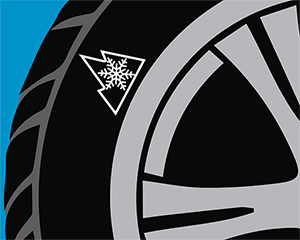
Regular or "all-season" tires, including wide and high-performance tires, may be adequate in some areas; but may not be suitable for driving in the snowbelt regions of southern Ontario and throughout the north. If you live and drive in these areas, consider using winter tires. They improve driving safety by providing better traction, braking and handling during frost, snow, slush, and particularly under icy conditions. Installing four winter tires provides greater control and stability. Never mix tires of different tread, size and construction. Also, consider adding traction control and stability control options when purchasing your next vehicle.
*Recommended tread depth from the Highway Traffic Act. Regulations 611 and 625.
**Source: Western Canada Tire Dealers. Used with permission.
It’s a good idea to keep a winter survival kit in your vehicle. Having essential supplies can provide some comfort and safety for you and your passengers should you become stranded.
Recommended items include:
- Ice scraper/snowbrush
- Shovel
- Sand or other traction aid
- Tow rope or chain
- Booster cables
- Road flares or warning lights
- Gas line antifreeze
- Flashlight and batteries
- First aid kit
- Fire extinguisher
- Small tool kit
- Extra clothing and footwear
- Blanket
- Non-perishable energy foods – e.g., chocolate or granola bars, juice, soup, bottled water
- Candle and a small tin can
- Matches
Did you know?
Not only can the candle and small tin help with lighting, but also generate some heat while waiting for help.
Wear comfortable clothing that doesn’t restrict your movement while at the wheel. Keep warm clothing for getting out of your vehicle.
If you are travelling a long distance, plan your route ahead of time. Let someone know of your destination and expected time of arrival.
Make sure you are alert and well rested.
Check weather and travel conditions before heading out. Don’t take chances if the weather is bad. Allow yourself extra time for travel, or wait until conditions improve. Reports on winter road conditions are available here:
http://www.mto.gov.on.ca/english/traveller/conditions/index.shtml
Visit the ministry’s Traveller Information Service website at www.ontario.ca/511 or call “511” for provincial highway information. This number is also listed in your local phone directory. Highway conditions are updated regularly.
If you experience car trouble on an Ontario provincial highway, we recommend that you stay in your vehicle to avoid personal injury.
If you are in an area with cell phone service and have a cell phone, use it only when necessary. When you need help, pull well off the road to make or receive a call.
Using hand-held cell phones and other hand-held electronic communication or entertainment devices while driving is against the law. Drivers who chat, text, type or use the touchpad of a prohibited hand-held device could be fined $155. Emergency calls to 911 are not affected.
Remember, dialing 911 on your cell phone will connect you with the emergency services contact centre in the area. Please use 1-888-310-1122 for non-emergencies.
Braking
Make sure you know how to use your braking system in all weather and road conditions. Consider taking an advanced driving course that teaches emergency driving skills.
How To Regain Control Of Your Vehicle In A Skid
A skid happens when your wheels slide out of control on a slippery surface. Skids can involve the front, rear or all four wheels. Most skids result from driving too fast for road or traffic conditions. Sudden, hard braking, going too fast on a curve or accelerating too quickly can cause your vehicle to skid and even roll over.
Once in a skid, steer in the direction of the skid. To do this, look where you want your vehicle to go and steer toward that spot. Be careful not to oversteer. If you are on ice and skidding in a straight line, step on the clutch or shift to neutral.
Your vehicle may have Threshold Brakes or Anti-lock Brakes. To find out how to regain control of your vehicle in a skid using either braking systems, visit the Driver’s Handbook Online at: www.mto.gov.on.ca/english/dandv/driver/handbook/section2.11.6.shtml
Remember:
It takes vehicles longer to stop in winter weather conditions and when driving downhill.
Stopping
In winter driving conditions, it takes all vehicles longer to stop on snow-covered roads. Below, the winter tire and all-season stopping distance comparison graphic is based on stopping in a straight line from a speed of 50 km/h.
Residents of Northern Ontario and out-of-province visitors can legally use studded tires. The stopping distances of studded tires are comparable to those of winter tires, under most winter conditions. Vehicles equipped with studded tires have a slightly shorter stopping distance on wet ice. On bare pavement the stopping distance of studded tires is longer.
You should not use your cruise control on wet, snowy or icy pavement. If your vehicle skids or hydroplanes, cruise control will causes your vehicle to continue to accelerate, reducing your reaction time and the ability to control your vehicle.
Did you know?
That winter tires that are in good condition can shorten braking distances by as much as 25%.
Source: Transport Quebec Safety Tips
Spacing
It takes longer to stop on a slippery road. It’s important to leave plenty of space between you and the vehicle ahead. A guide to safe spacing under normal driving conditions is the two-second rule.
Two-second rule:
- Pick a marker on the road ahead, such as a road sign or telephone pole.
- When the rear of the vehicle ahead passes the marker, count "one thousand and one, one thousand and two".
- When the front of your vehicle reaches the marker, stop counting. If you reach the marker before you count "one thousand and two,” you are following too closely.
In winter, and especially during poor weather conditions, double the two-second rule.
Snow
Snow on a road may be hard-packed and slippery as ice. It can also be rutted and full of hard tracks and gullies. Or it can be smooth and soft. Wet snow can make for slushy roads. Heavy slush can build up in the wheel wells of your vehicle and can affect your ability to steer. Remember, look far ahead as you drive so you can recognize hazards and have plenty of time to respond. Adjust your driving to the road and weather conditions. Slow down to avoid sudden turns of the steering wheel and sudden braking and accelerating, which could cause a skid. Extra caution should be exercised when driving in these road conditions.
Ice
Be careful when approaching shaded areas, bridges and overpasses, as these sections of road freeze much sooner in cold weather and stay frozen long after the sun has risen. Watch out for frost and areas of the road that appear black and shiny, as they can cause your vehicle to suddenly lose traction. Slow down, keep your foot off the brake and be ready to shift to neutral or step on the clutch as your vehicle crosses these areas.
Snow and Slush Spray
On snowy, wet and slushy roads, large trucks and buses can blow moisture onto your windshield, leading to a sudden loss of visibility. Always drive defensively and leave enough space to avoid snow spray.
Visibility
It is critical for drivers to see and be seen in low light conditions and when blowing snow and white-outs impair visibility. Whenever visibility is poor, turn on the vehicle’s full lighting system.
More information on driving in blowing snow and whiteout conditions is available here: http://www.mto.gov.on.ca/english/safety/topics/badsnow.shtml
Play it Safe!
Severe winter driving conditions may make you nervous, uncomfortable or fearful. Stay off the road unless your trip is absolutely necessary. Proper preparation and the right skills will help you face the challenge of winter driving.
If you get stuck or stranded, don’t panic. Stay with your vehicle for safety and warmth. Wait for help to arrive. If you are in an area with cell phone service and have a cell phone, call for help. Remember, dialing 911 on your cell phone will connect you with the emergency services contact centre in the area. Please use 1-888-310-1122 for non-emergencies.
Be careful if you have to get out of your vehicle when on the shoulder of a busy road. If possible, use the door away from traffic.
If you attempt to free your vehicle from the snow, be careful. Dress warmly, shovel slowly and do not overexert yourself. Do not attempt to shovel or push your vehicle if you have a medical condition. Body heat is retained when clothing is kept dry. Wet clothing, due to the weather or perspiration, can lead to a dangerous loss of body heat.
Draw attention to your vehicle. Use emergency flashers, flares, or a Call Police sign. Run your motor sparingly. Be careful of exhaust fumes. For fresh air, slightly open a window away from the wind. Exit your vehicle occasionally to make sure the exhaust pipe is clear of drifting snow before running the engine.
In blizzard conditions, especially overnight, make sure one person stays awake, because help could take some time to arrive. Maintain circulation by moving your feet, hands and arms.
Echelon plowing is the practice of staggered snowplows operating across all lanes of a highway in one direction. It is the safest and most efficient snow removal method for multi-lane highways, though sometimes annoying to drivers. Plowing in echelon clears all lanes at once by passing a ridge of snow from one plow to the next.
Leaving Room for Plows
Remain a safe distance back from maintenance equipment when you see blue flashing lights. To do the job right, snowplows and salt and sand trucks must travel slower than regular traffic. Sight lines and visibility near a working snowplow are significantly reduced by blowing snow. Passing is dangerous.
Stay well Back to Help Snowplows Do Their Job!
When you see the blue flashing lights of a snow plow, remain a safe distance back.
When encountering a plow coming from the opposite direction, move as far away from the centreline of the pavement as you safely can.
At no time should a vehicle pass a snow plow on the right-hand side. This could result in severe, even fatal, collisions.
The Ministry of Transportation uses advanced tools to improve snow and ice control. Some tools currently in use are:
- Road and weather information sensors help maintenance crews make the best and most timely decisions on how to deal with winter conditions.
- Anti-icing liquid, which is spread on the road prior to winter storms, stays in place, melts frost and prevents snow from bonding to the road surface and increases the effectiveness of plowing early in the storm.
- Stationary automated anti-icing systems prevent slippery conditions.
- Electronic spreader control equipment spreads salt and sand to ensure the correct amount is distributed.
- De-icing liquids added to dry road salt melt ice and snow faster and stays on the road better than dry salt alone.
- Global positioning systems and data collection help to manage winter snow and ice control operations.
- Tow plows are a full-length, trailer-mounted plow blade, capable of clearing multiple lanes of traffic by operating as a side-wing when maneouvered into an adjacent lane.
Managing Snow and Ice With Salt
Road salt is the most cost effective snow and ice control materials available. Timely application of salt prevents snow and ice from bonding to the road surface. For this reason, salt is often spread early in a storm to prevent snow buildup and to aid in snow removal operations. In some areas, anti-icing liquids are applied directly to the pavement to minimize bonding. The effectiveness of road salt is assisted by the sun, traffic and warmer daytime temperatures. You may notice that salt is often applied in a narrow strip along the centre or high point of the highway. This row of salt develops into a salt-water mixture, which flows across the highway, ensuring the most efficient and effective use of the material.
The Ministry of Transportation is investigating ways to control and reduce the use of salt and its impact on the environment, while ensuring highway safety.
Sand, salt and anti-icing liquids play a big role in keeping roads safe.
Did you know?
Road salt works poorly when temperatures drop below -12o C. That is why bare pavement can be difficult to achieve in extremely low temperatures.
Providing Traction
Sand is used to provide traction on slippery surfaces. Unlike salt, it does not melt snow and ice. Sand is used most often when temperatures are too low for salt to be effective. Sand is also used at higher temperatures if traction is required immediately, particularly on hills, curves, bridges, intersections, and snow-packed roads.
Contracting of Snow and Ice Control Services
Snow and ice control services are provided through contractors, which are directly responsible for responding to a variety of winter conditions. These contractors are governed by contract standards, specifications and required performance outcomes.
The Ministry of Transportation sets the standards for snow and ice control services, dictates the performance outcomes and oversees the contracts to ensure compliance. The ministry has several options available to ensure contractor performance. The ministry audits contract operations to ensure contractors are compliant and that performance outcomes are achieved. Consequences for non-performance can be severe.
Maintenance contractors perform the following activities:
Before a Storm
- Check for changing road and weather conditions.
- Make sure staff, supplies and equipment are ready and available.
- Apply anti-icing liquid to the highway surface at the appropriate time.
- Plan when to start salting, sanding or plowing operations.
During a storm
- Continue to check road, weather and traffic conditions.
- Apply salt or anti-icing liquid to help prevent the snow from bonding to the highway surface.
- Allow time for the salt to do its job.
- Follow pre-determined routes to ensure the busier highways are serviced first.
- Start plowing the snow from the through lanes.
- After the through lanes are cleared, start removing snow from exit ramps, turning, truck climbing and passing lanes, shoulders and medians.
- Continue plowing snow and applying salt and sand throughout the storm to minimize snow accumulation and maintain traction.
- When it is too cold for salt to work, apply sand to the highway to improve friction.
- Assist the OPP with road closures and emergencies when required.
- Restock salt, sand and anti-icing liquids as required.
After a storm
- Continue to check road, weather and traffic conditions.
- Continue to plow, salt or sand the highway until the surface returns to bare pavement standards.
- Remove snow from shoulders, medians, truck climbing and passing lanes.
- Remove any snow banks that may cause a hazard.
- Remove any snow or ice that may cause drainage problems at ditches and culverts.
- Check for damage to items such as signs and guiderails that may have occurred during the storm and make repairs.
- Inspect and, if required, repair winter equipment.
- Restock salt, sand and anti-icing liquids.
The public can expect:
- Plowing, salting or sanding and clean-up after the storm.
- Plowing to commence when 2 cm of snow or slush accumulate on the roadway.
- Equipment to be deployed within 30 minutes of the start of a winter storm.
- Crews monitoring the winter storm and adjusting operations as required for intensity, duration and precipitation type.
To view a list of area maintenance contractors and phone numbers, click here.
To view a map of the maintenance contract areas and phone numbers, click on the links below:
Northern Ontario - PDF (1.82 MB)
Southern Ontario - PDF (1.18 MB)
To send us an e-mail about road conditions on Ontario highways, click winterhighways@ontario.ca
The public should be aware, however, that in winter:
- A severe or long storm may delay restoring highway to bare pavement standards, even with the best efforts of highway crews.
- It may take up to eight hours for plows or sanders to begin servicing ramps and low-volume roads.
- Extreme weather may result in the closing of highways.
- Weather conditions can be variable and unpredictable, placing extra demands on a vehicle and a person’s driving skills.
- Salt becomes ineffective for melting ice and snow at temperatures below minus 12˚C.
MTO sets performance targets for snow and ice control to achieve the bare pavement standard after the end of the storm. The bare pavement standard for each class of highway is:
- Eight hours for freeways and multi-lane highways, e.g. Highway 401, Queen Elizabeth Way, Highway 11 and four-lane sections (Class 1).
- Sixteen hours for high traffic volume, two-lane highways, e.g. Highway 17 Trans-Canada (Class 2).
- Twenty-four hours for medium traffic volume, two-lane highways, eg. Highway 35 (Class 3).
- Twenty-four hours to centre bare for low volume, two-lane highways, e.g. Highway 516 (Class 4).
- Some highways with low traffic remain snow packed for most of the winter (Class 5).
- On Class 5 highways, excess snow is plowed off and sand is applied to improve friction.
Every day, police, fire, ambulance and other emergency vehicles respond to urgent calls. Time lost getting to their destination could mean the difference between life and death. Seconds can save a life.
Take flashing red and blue lights and sirens seriously. Clear the way. It’s the law for any motorist who sees and hears an emergency vehicle approaching from either direction to move out of the way. Signal, then pull to the right and stop.
When approaching a stopped emergency vehicle in the same direction of travel, either in a lane or on the shoulder of the road, with its lights flashing, motorists are required to slow down and pass with caution. If the road has two or more lanes in the direction of travel, the motorist must move over into another lane, if it can be done safely.
Extreme weather may result in the closing of highways. Respect highway closures and do not attempt to drive on these highways until they are re-opened. Always obey emergency road closing signs and barriers and follow the directions of any police officer. It's for your safety. Remember, it is against the law to drive on a closed highway.
Did you know?
The police have the authority to close highways. Sometimes the safest and best action is to close a highway until weather conditions improve enough to allow snow and ice control.